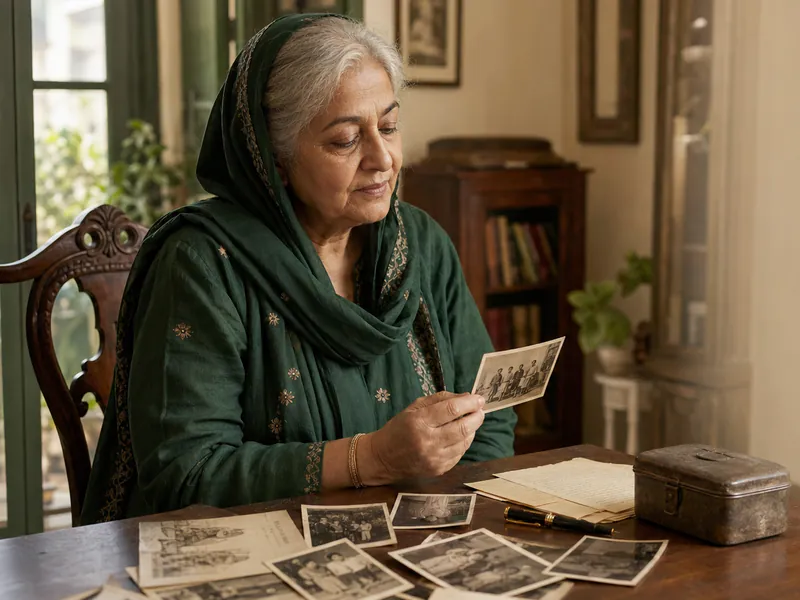
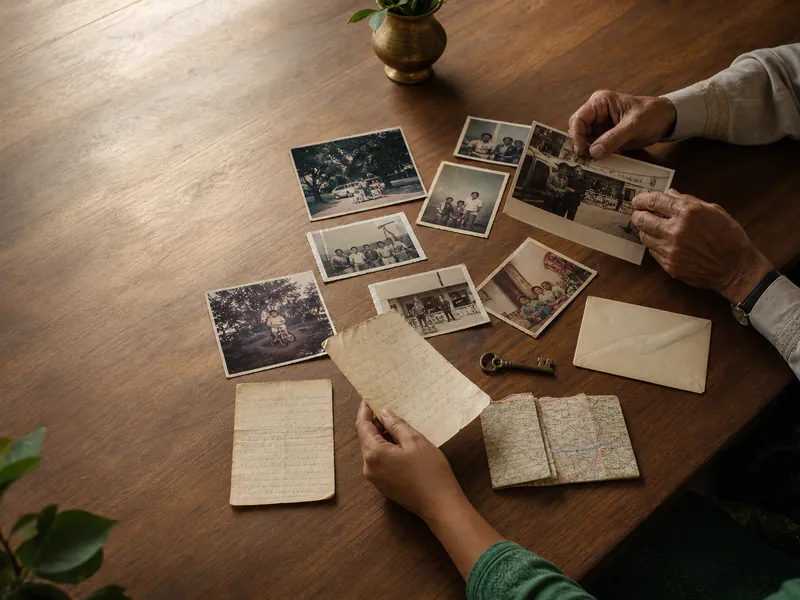
You do not need polished writing to begin. A simple answer, a half-remembered scene, or one old photograph can become the start of a chapter your family can keep.
Most people worry their answers are too plain. Often, plain is where the truth is. The work is to keep the voice and add enough rhythm, context, and shape for someone else to read it.
Before editing
Question: Describe your first day at your first real job.
It was 1974. I was 22. I worked at the state bank in the city. I wore a tie, it felt itchy. My boss was Mr Henderson. He was strict but fair. I remember the smell of old paper and tobacco. Everything was done by hand back then. I felt like a grown-up for the first time.
The StoriLeaf book narrative
By the summer of 1974, I was twenty-two and ready to claim my place in the world. My first real post was at the State Bank, a grand, echoing building in the heart of the city that always smelled faintly of old parchment and Mr Henderson's tobacco.
I still remember the itch of the wool tie against my neck, a small price to pay for the seriousness of the role. Tucked into my corner desk, pen in hand, the weight of the ledgers felt like the weight of adulthood itself.
Book excerpt
A chapter you can actually read.
The book preview below shows how a small memory can hold movement, family context, and a feeling that lasts beyond the event itself.
Chapter 4
The Blue Suitcase
The train was already breathing when we reached the platform. My mother held the blue suitcase in both hands, as if the whole house had been folded into it. I was too young to understand the move, but old enough to know that everyone was speaking softly.
A story is not only what happened. It is what people learn to remember together.
My father checked the tickets twice, then looked at me and said, "We will be fine." At the time, I thought he was only talking about the journey. Years later, I realised he was teaching us how to begin again without making fear the loudest thing in the room.
Photographs can sit beside the story, with captions that preserve names, places, and context.
That blue suitcase became our family's shorthand for courage. Whenever someone had to start over, my father would smile and say, "Take the blue suitcase." It meant we had done difficult things before. It meant we could do them again.
What changes
The original memory stays intact. The final book adds pacing, context, scene-setting, and a chapter frame that makes it easier for family members to follow.
What stays yours
Your voice, photographs, names, and family details remain yours. The editing should make the book clearer, not make it sound like someone else.
Your story does not need to arrive perfectly.
It only needs a starting point. The questions, structure, and editorial care can come next.