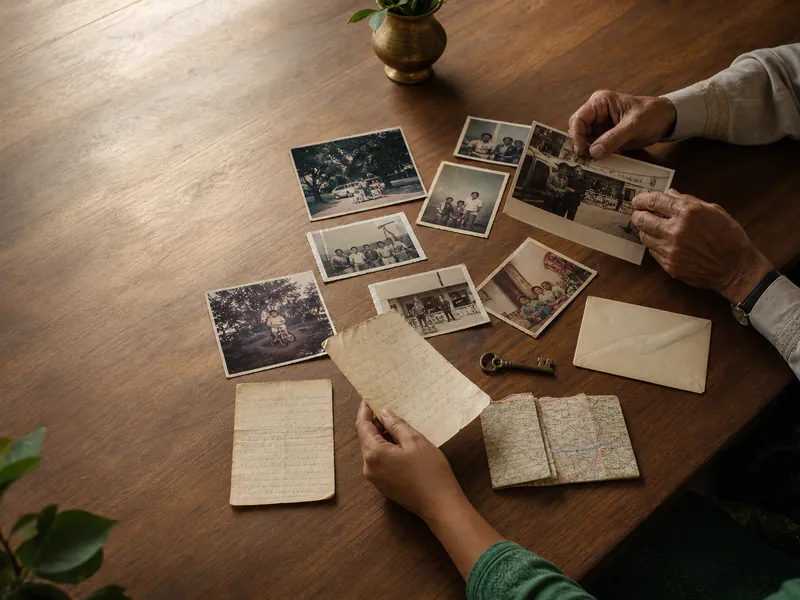
Most families have more photographs, messages, and videos than they could ever sort through. Still, the real story can slip away. A phone can hold the image, but it usually does not hold the name, the reason, the joke, or the feeling around it.
Photographs need context
A picture can show who was there, but it may not explain why the moment mattered. Without names, places, relationships, and feeling, even meaningful images can become unclear to the next generation.
Preserving family history means pairing visual material with the memories that give it weight.
Stories carry values
Family history is not only a record of events. It also holds the values, choices, humour, resilience, faith, ambition, and tenderness that shaped a family.
Those qualities are hard to recover from documents alone. They live in stories people tell in their own words.
Digital files still need curation
A folder of thousands of images is not the same as an archive. Curation helps families choose what matters, name it clearly, and make it easier to revisit.
The aim is not to save everything. The aim is to preserve what will still be meaningful later.
Start by choosing a small set of photographs that represent people, homes, rituals, work, travel, celebrations, and turning points. Then add names, places, dates, and one or two lines about why each image matters.
Distance makes context more important
When families live in different places or across generations, the gap between a photograph and its meaning can widen quickly. Children may recognise grandparents, but not the family home, everyday habit, move, or reason a particular visit mattered.
A preserved family history gives relatives a shared reference point. It can explain what people carried with them, what changed, and which stories still shape the family today.
A keepsake should be easy to return to
A useful family history is not only stored safely; it is also easy to read, share, and revisit. That is why a personal story keepsake often works better than a scattered folder or chat thread.
Chapters, captions, audio notes, and a clear order help future readers understand the material without needing someone beside them to explain everything.
Begin before it feels urgent
Many families wait until a milestone, illness, move, or loss makes the work feel urgent. Starting earlier gives the storyteller more comfort, choice, and time.
Even a few guided questions can protect details that might otherwise fade.
The digital age gives families tools, but attention still does the real work. A preserved story is context, not just a folder of files.