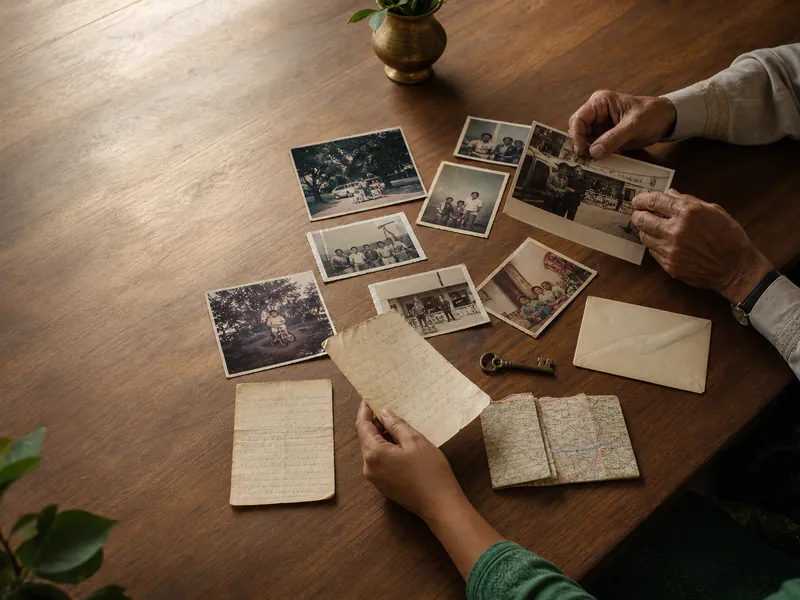
A family story does not need dramatic events to matter. It needs a clear scene, a few human details, and enough context for someone years from now to understand why the memory stayed.
Choose one memory at a time
Trying to write the whole family history at once can make the task feel impossible. Start with one memory: a journey, a first home, a celebration, a difficult decision, or a person who shaped everything.
Small stories are easier to finish, and several small stories can later become a larger memoir.
Anchor the story in detail
Names, places, smells, sounds, weather, clothing, food, and objects make a story feel alive. The detail does not need to be decorative; it simply helps the reader enter the moment.
A blue suitcase, a railway platform, or a familiar kitchen can carry more feeling than a broad summary.
This is especially true for family history that crosses homes, cities, or generations. A reader who has never seen the old house, the first flat, the workplace, or the room where everything changed needs concrete details to feel close to the memory.
Explain why it stayed with you
The event is only part of the story. The meaning often comes from what the storyteller realised later.
Ask: What did this change? What did it teach you? Who did it bring closer? What do you still understand because of it?
Keep the language natural
A family story should sound like the person or family it belongs to. Simple, direct language is often more moving than polished writing that feels distant.
The best editing adds clarity without removing personality.
Give readers enough context
Future readers may not know family nicknames, old job titles, household references, place names, or why a particular journey mattered. Add enough explanation for someone outside the immediate moment to follow the story.
Context does not need to slow the writing down. One sentence can explain who a person was, where a place was, or why a decision carried weight.
Use structure without making it stiff
A good keepsake needs order, but it should not feel like a report. You can organise stories by life phase, place, person, theme, journey, or lesson.
For many families, the strongest structure is a mix: childhood, family roots, work, love, parenthood, family moves, travel, values, and the messages the storyteller wants to leave behind.
Future generations do not need a perfect literary performance. They need stories that feel true, specific, and generous enough to return to.