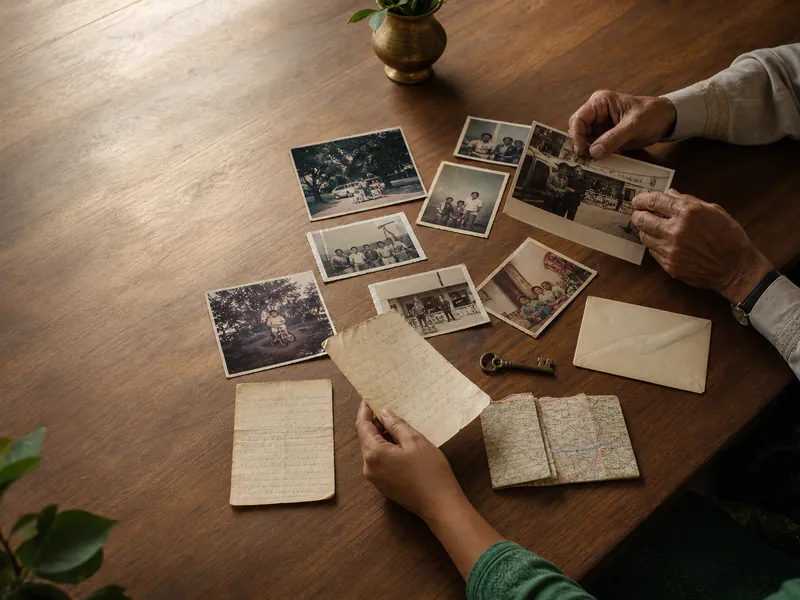
A keepsake works best when people actually return to it. The most meaningful family objects are not always elaborate; they are the ones that help someone remember a person, a place, or a moment with a little more clarity.
Create a chaptered story book
A printed or digital story book can gather memories, photographs, captions, and family context into one coherent object.
Chapters make the material easier to read and help different family members find the stories they care about most.
For a parent or grandparent, chapters might follow childhood, education, work, marriage, children, family moves, favourite places, and lessons learned. For a traveller, they might follow routes, places, companions, turning points, and the journey home.
Pair photographs with captions
A simple caption can preserve names, dates, places, relationships, and the story behind an image. Without that context, even beautiful photographs can become difficult to understand.
Ask the storyteller what they want someone to know when they see each photograph years from now.
Build a travel memory archive
Trips often leave behind tickets, maps, photographs, restaurant names, routes, and small rituals. A travel memoir can turn those fragments into a story of movement and meaning.
This is especially valuable for milestone journeys, pilgrimages, honeymoons, family holidays, and long-awaited adventures.
Families often have trips that explain more than a destination: a return to an important place, a family reunion, or a holiday that became part of family language.
Record a few spoken memories
Voice can carry warmth that text cannot. Even short recordings can preserve tone, humour, pauses, and emotion.
Written stories and audio memories can work together, especially when family members want both readability and presence.
Turn one gift into a family project
A keepsake gift can invite more than one person into the process. One family member may contribute photographs, another may remember dates, and the storyteller can add the voice, feeling, and meaning.
This is useful when family members live in different places. A shared keepsake gives everyone a clear reason to gather material before it becomes harder to find.
Choose a format people will actually use
Every StoriLeaf keepsake becomes a book at minimum, because a book can sit on a shelf, pass from hand to hand, and stay precious across generations.
Before choosing any additional outputs, ask who will read it, how often they might return to it, and whether the storyteller would enjoy contributing by writing, speaking, selecting photographs, or answering guided prompts.
A lasting keepsake is not only about preservation. It makes the memory easier to hold, understand, and share.