Recording a parent's life story can feel important and oddly hard to start. You do not need a perfect interview plan. You need a calm moment, one good question, and enough patience to let the answer wander a little.
Start with ordinary moments
Big life events matter, but ordinary memories often carry the richest detail. Ask about the street they grew up on, the first kitchen they remember, the neighbour everyone knew, or the sound of a family routine.
These questions feel easier than asking someone to summarise their whole life, and they often lead to deeper stories without pressure.
For families who do not see parents or grandparents every day, this is also a gentle way to reconnect. A short call about a school uniform, a favourite celebration, a first job, or a childhood home can open memories that would never appear in a normal catch-up.
Use photographs as gentle prompts
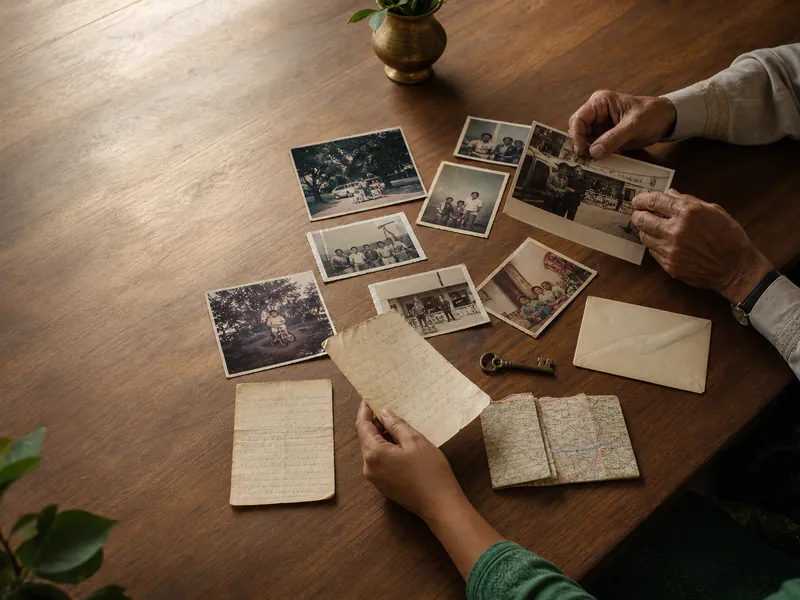
A photograph gives the conversation something to rest on. It can bring back names, places, clothing, celebrations, and small details that a direct question might not reach.
Ask what happened just before or after the photograph was taken. That is often where the story begins.
Keep sessions short
Long interviews can become tiring, especially for older storytellers. A short, focused conversation is usually more useful than trying to cover decades in one sitting.
End while the person still has energy. It makes the next conversation feel welcome instead of heavy.
If you are recording across time zones, agree on one question before the call begins. That small boundary keeps the conversation relaxed and makes it easier to continue week after week.
Let their voice stay intact
Family members naturally want to help, but a life story should not be polished until it no longer sounds like the person who lived it.
Keep turns of phrase, humour, pauses, and personal ways of describing people. Those details are part of the inheritance.
Ask for people, places, and relationships
Family stories become more useful when names and relationships are clear. Ask who else was there, how people were related, where the moment happened, and what the place was called at the time.
This matters especially for younger family members who did not live through the moment. They may know a photograph is important, but not the home, nickname, or family connection behind it.
Build a shape later
You do not need to organise everything at the beginning. Gather memories first, then group them by life phase, place, relationship, lesson, or theme.
Structure helps the story become readable, but it should serve the memories rather than rush them.
A personal story keepsake can begin as a handful of conversations. The chapters, photographs, captions, and finished book can come later once the family knows what material feels most meaningful.
A life story begins with attention. When someone feels heard, the details often arrive with more warmth than a formal interview could ever pull out.